Why?
Why maximize VMG (Velocity Made Good)? How did we get here?
While foiling opened up so many ways to ride swells, by the beach or open water, the massive distances covered quickly raised the question of how to get up, and how to get back to the starting point?
In the surf, prone and sup are still relevant methods although longer waves have been begging for electric assistance either on the board, as a backpack, or a tow boogie.
In the open waters downwinding, car shuttle and winging were since 2019 the 2 suboptimal solutions, where car shuttle implies logistics and paddling up, and winging implies holding the bloody thing going downwind.
Now with parawinging and decent designs starting to go upwind efficiently, it is possible to downwind hands free, and shuttle free. If the upwind leg can be made efficient, it opens up surfing 2.0 in any body of water around the world with enough fetch, with no limited supply problem like sticky surfing.
So VMG is the limiting factor of an almost unlimited downwinding potential. It is in my opinion the most important, and the most interesting thing to focus on.
Current speeds
I am currently using the following gear, in 14 to 30+ knots, in south Sweden with fetches between 15 and 150km :
777 hybrid 4.3 and 5.7 / PPC Orbit 3.5 and 4.5
Afs silk 750-950, enduro 800, titanium fuse, afs 85 uhm mast, kparts universal slim 82cm, ucarve 130, carve pro S
Homemade XPS vacuum carbon board 6’3 18’5 ~65L for 80kg rider, 4kg.
Tracking with Garmin solar watch, analysis with https://chiffometre.netlify.app/.

—
On the 777 hybrids, VMG is varying from 6 to 8 kts, when on the top of the advised range, meaning above 16kts for the 5.7 and above 20kts for the 4.3. They have quite a bit of camber in the profile which is great to get up and going, but create a lot of pull when the wind picks up, which become a harness opposition battle, kitefoil style.
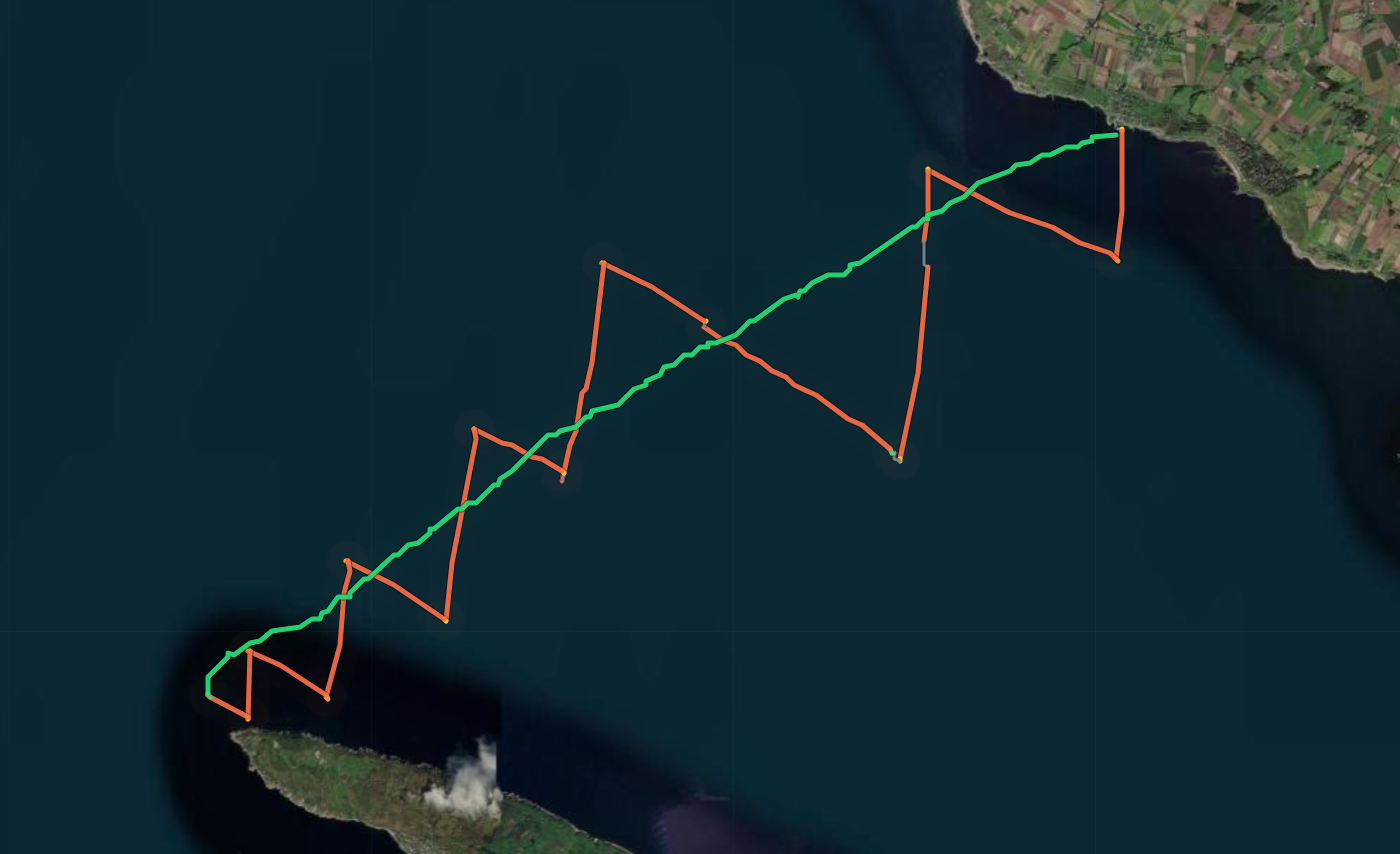
Below, a 25kts wind day on the 4.3m hybrid, enduro 800 and 85cm mast, 15km upwind leg, average vmg 7kts.


On the PPC, VMG seem to be a touch higher, 7 to 9 kts, mostly due to a higher average speed, the angle seem to be similar. It seems like the 4.5 starts to perform at 18kts and the 3.5 at 20-22kts of wind. Their camber is adjustable which is awesome, industry changing imo, so the bar pressure can be adjusted depending on wind conditions. Despite being a bit more cumbersome, longer to pack, and less pull to get up than the hybrids, I deeply love the feel they give. It feels like a soft formula one that just wants to accelerate in a comfortable fashion.
Below, a 25+kts wind day on the 3.5m ppc, enduro 800 and 85cm mast, 16km upwind leg, average vmg 7.4kts. Much much more comfortable than the session above on the hybrid.


So where do we go from here?
On the technique side.. chatted with Lachie White recently and he is saying he is averaging 8 to 12kts of vmg (peaks at 15!) on an orbit 3.5, uni evo 155, across a variety of wind direction/strength in Port Phillip Bay which is has weak tides.
On the gear side, it seems like the orbit is currently the best solution for this use case. Supposedly a v2 comes up next year with improved performance. I hear the Flysurfer Zap has even better upwind, but the tradeoff is costly. Thicker fabric than orbit/hybrid (>30g) so it packs big, longer lines (5 and 6.5m super long), smaller holes in the trailing edge (longer time to empty the air and water than the orbit). For lighter winds (12 to 18kts), an afterburner type parawing is probably the best fit. Waiting to see if another brand comes up with a cheaper version.
Leave a Reply